BRE in the Innovation Economy: The Free Data Layer Economic Developers Have Been Waiting For
Right now, there are companies in your jurisdiction planning to raise capital to scale. They are growing fast, hiring, and making decisions about where to base their next phase of growth. Most Economic Development programmes have no idea they exist.
That is not a failure of effort. It is a failure of data.
The Blind Spot in Traditional BRE
Business Retention and Expansion programmes have long been the cornerstone of local Economic Development strategy. Surveys, face-to-face engagement, business registers, employment data — these tools have served EDOs well for decades. But they were built for a different kind of economy.
The fastest-growing segment of any modern regional economy — companies at the cutting edge of innovation, actively seeking capital to scale — largely sits outside the reach of traditional BRE intelligence. These businesses do not always have large physical premises. They do not always respond to survey outreach. They are moving quickly, and by the time they show up in a business register or employment dataset, the moment for intervention has often already passed.
The result is a significant and largely unacknowledged gap: EDOs are doing BRE without the data to find the companies that matter most.
What the Shipshape.vc Data Shows
Shipshape.vc is an investment search engine that connects companies seeking capital with relevant investors. Companies register on the platform and provide structured details — employee numbers, postal and zip codes, the capital they are seeking to raise. In doing so, they create something that has never existed before: a real-time, geocoded dataset of growth-stage companies at the precise moment they are looking to invest in their own future.
The numbers are significant. The global dataset covers 5,496 businesses with a combined profile that includes:
- $2.75 billion in annual revenue run rate
- $13.4 billion in planned capital raises (self-declared target raise sizes)
- $53 billion in combined pre-money valuation
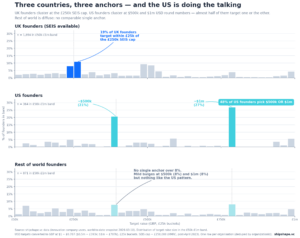
Approximately 200 new companies join the platform each month globally. Every one of them represents an active growth signal — a business that has put its hand up and declared it is seeking investment to scale. Target raise sizes vary considerably. More than half of companies on the platform are planning to raise less than $1 million, making them early-stage businesses where timely intervention can be genuinely transformative. Around 38% are targeting between $1 million and $5 million — the growth-stage sweet spot where export programmes, grant support, and investor introductions can meaningfully shape the outcome. A further 9% are targeting between $5 million and $20 million, and 2% above $20 million. The median target raise, at just under $1 million, reflects a platform that skews toward the earliest and most intervention-sensitive stages of the innovation journey.
That is a BRE signal most Economic Development programmes have never had access to before.
From Data to Timely Interventions
The value of this data layer is not simply that it exists — it is that it arrives at the right moment. A company that has declared plans to raise capital is a company making decisions: about hiring, about location, about which advisers and partners to work with. An EDO that knows about that raise before it closes has a window to act. An EDO that finds out twelve months later does not.
The range of interventions the data makes possible is broad:
Fundraising support. Many innovation-economy companies do not know what local co-investment schemes, angel networks, or match-funding vehicles are available to them. With this data layer, EDOs can reach out proactively and make introductions at exactly the right moment — before the raise closes and the opportunity passes.
Export programmes. Scale-ups seeking capital often have international expansion in their plans. EDOs running export or trade programmes can use the data to identify businesses at the right growth stage and make them a timely offer, rather than relying on businesses to find the programme themselves.
Grants and incentives. Grant programmes frequently go undersubscribed not because eligible businesses do not exist, but because they never hear about them. Matching grant criteria to live business profiles in the data layer allows targeted, proactive outreach — to businesses that actually qualify, at the moment they are most receptive.
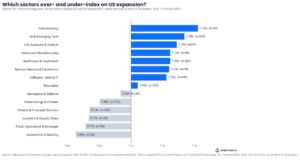
Policy and programme formation. At a strategic level, the aggregate data is equally powerful. The dataset reveals, for example, that AI and machine learning companies account for $4 billion of total target raises across the platform — more than four times the next largest sector, HealthTech and Life Sciences at $959 million. SaaS and Enterprise Software ($811 million), FinTech ($793 million), DeepTech and Hardware ($595 million), and CleanTech and Energy ($570 million) round out the top six. For an EDO designing programmes around the sectors most actively seeking capital in their jurisdiction, this kind of structured evidence has not previously been available.
Grow London: What This Looks Like in Practice
The map below shows the data layer in action for Greater London.
Grow London, which supports high-growth businesses across the capital’s 33 boroughs, uses the Shipshape.vc data layer to identify companies planning to raise capital within their jurisdiction. The density of activity shown in the map is striking: 1,292 company locations plotted from real geocoded data, spread across the inner and outer boroughs, with the expected concentrations in established innovation corridors — each dot a live growth signal derived from an actual company registration.
On average, 30 new companies appear in the Greater London dataset each month — part of a global intake of approximately 200 new businesses joining the platform each month. Each one is a business that has already self-selected as a growth company seeking capital, and each one is reachable through the platform. The programme finds companies rather than waiting for them to make contact.
Where the Service Is Already Working
Thirty Economic Development organisations across three continents are already working with this data layer.
In the United States, state-level partners include New Jersey, Colorado, and New Mexico. New Mexico’s engagement is notable in the context of a broader transformation underway in the state’s innovation economy — one accelerated by significant inward investment, including Microsoft’s substantial commitment to the Albuquerque region. Tracking the growth-stage companies this kind of investment catalyses requires exactly the kind of real-time data that traditional BRE methods cannot provide.
In the United Kingdom, city-level partners include London, Cardiff, Manchester, and Bristol. At a national and international scale, the service is also working with Trade and Innovation Agencies operating at country level in Malaysia, Norway, and the UK itself.
Across these partnerships, EDOs report dozens of companies supported through export programmes, fundraising introductions, and grant offers — self-reported outcomes from a data capability that simply was not available to most of these organisations eighteen months ago.
How the Data Layer Works
Companies that register on Shipshape.vc provide structured details including their employee count, postal or zip code, sector, and the capital they are seeking to raise. This data — continuously updated as new companies join, and geocoded using precise latitude and longitude coordinates — is made available to EDOs within their jurisdictional boundaries.
Access is geographically bounded: an EDO covering Greater Manchester sees only companies within that footprint. A state-level partner sees only their state. No two partners see each other’s data.
The service is free to Economic Development Organisations and Local Authorities. There are no licensing fees, no data subscriptions, and no minimum commitment.
A Note on the Data
All figures cited in this article reflect the live Shipshape.vc dataset at the time of publication, and will evolve as new companies join each month. Company details are self-reported at registration; the platform does not independently verify revenue or valuation figures. Outcome data referenced — companies supported through export programmes, grant offers, and fundraising introductions — is self-reported by EDO partners.
Whilst we continue to monitor these figures and the dataset grows, the directional picture is clear: the innovation economy has an active, structured, and largely untapped BRE data layer. It is available now, it is free, and it is already working.
See What’s Active in Your Jurisdiction
If you are responsible for Economic Development in your region and would like to see which companies in your area are planning to raise capital right now, we would be happy to walk you through it.