shipshape.vc research · November 2026
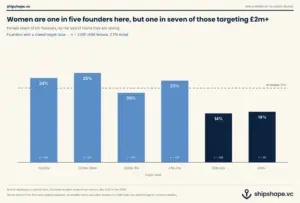
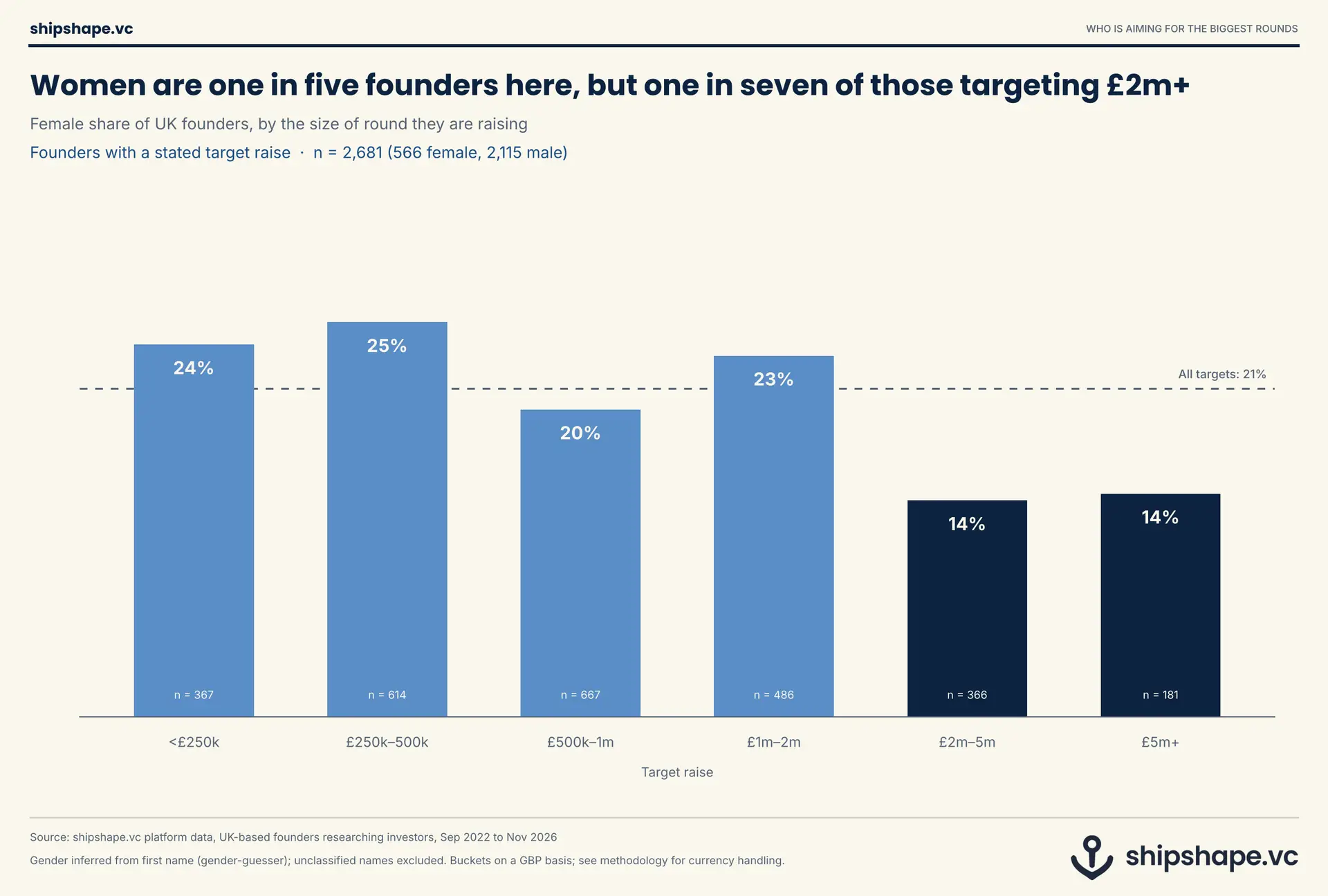
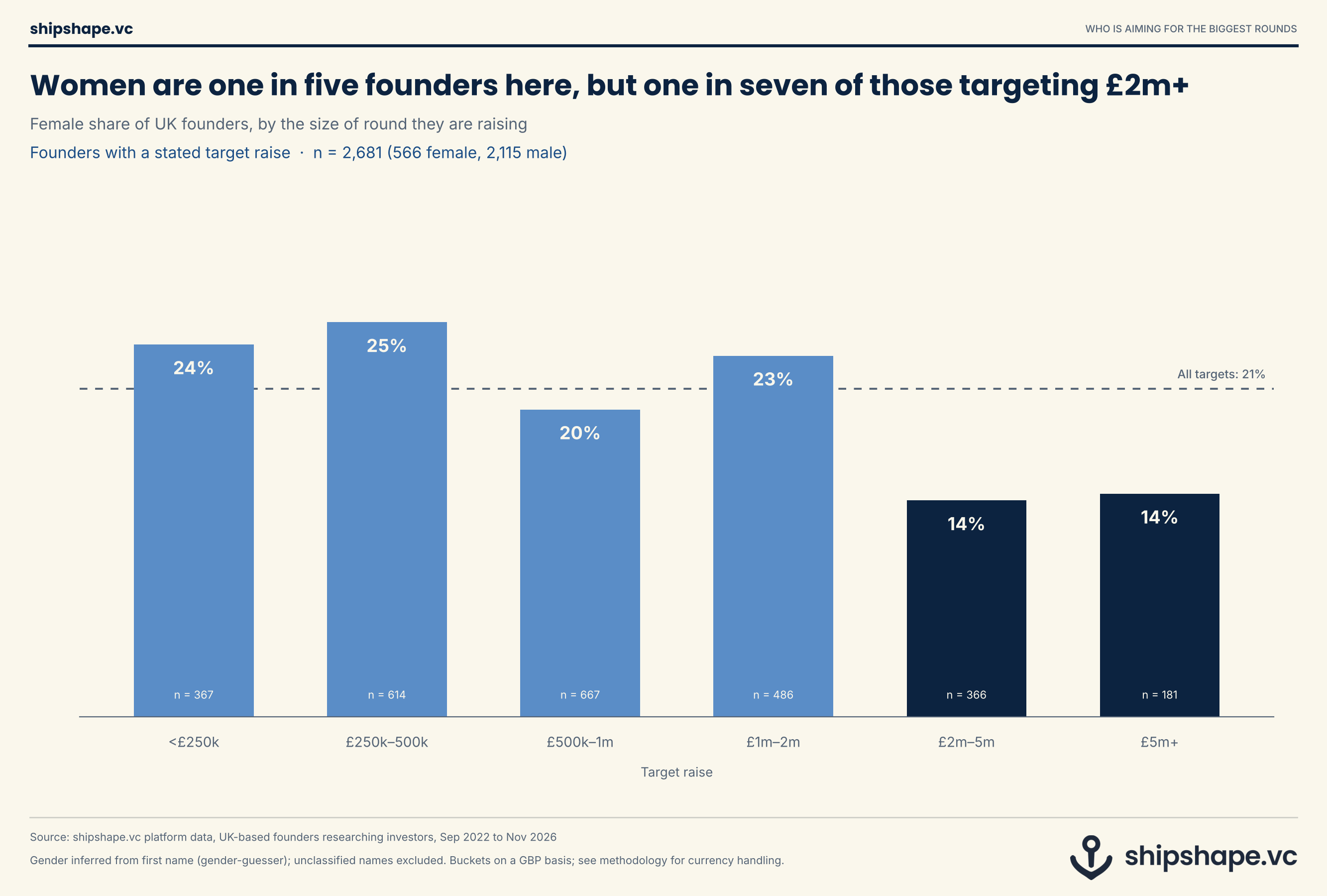
Female and male founders in the UK ask for almost the same amount of money. The difference is at the top: women are one in five founders seeking capital on shipshape.vc, but one in seven of those aiming to raise £2m or more. That gap holds after accounting for revenue, valuation, stage, funding history and sector.
Most research on the gender funding gap looks at money that has already been invested. This report looks one step earlier, at how much founders set out to raise. It is based on 3,286 UK founders who used shipshape.vc, a free investment search engine, to research investors between September 2022 and November 2026.
Key findings
- Typical targets are almost the same. The median female founder is raising £502k; the median male founder £518k.
- The gap is in the largest rounds. 14% of female founders target £2m or more, against 22% of male founders.
- A few large rounds hold most of the money. Founders targeting £5m or more are 7% of the sample but ask for 51% of all capital sought. Women are about one in seven of them, as they are in every band above £2m.
- It holds after controls. Compared with similar male founders, female founders are 6.0 percentage points less likely to target £2m+ (odds ratio 0.59, p < 0.001). The result holds in all 12 robustness checks.
- The adjusted gap is clearest above £1m. Exactly £1m is a popular target for women. Just above it, from £1.25m to £3m, female founders have about 35–40% lower odds of aiming that high than comparable male founders.
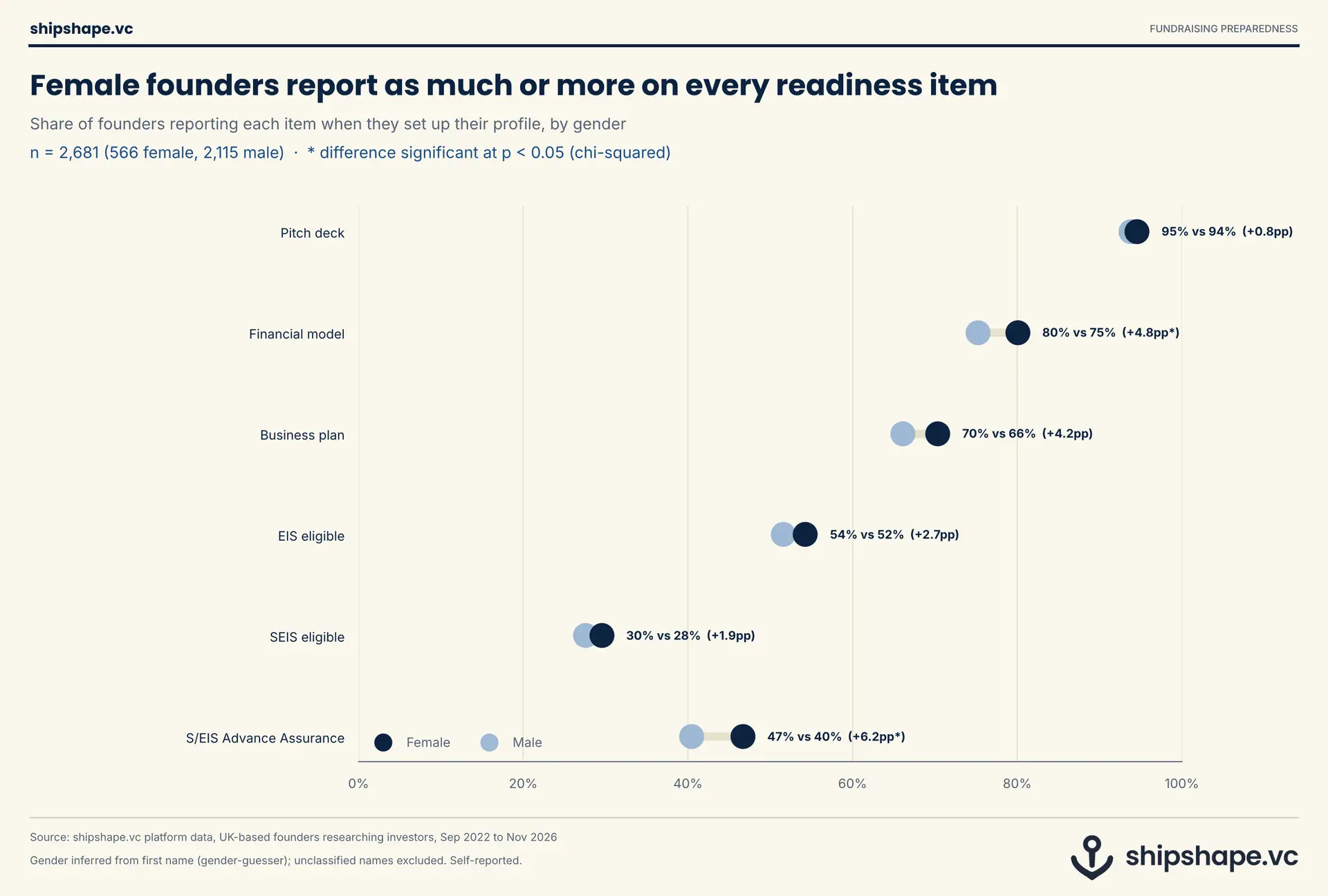
- Women are at least as prepared. Female founders report equal or higher rates on all six readiness measures, including financial models (80% vs 75%) and S/EIS Advance Assurance (47% vs 40%).
- Women are as likely to have raised before. 54% of female and 54% of male founders report raising external capital already.
Why this matters
Headline funding statistics are measured by value, and value is dominated by large rounds. All-female founder teams receive about 2% of UK equity investment (British Business Bank), yet women are about one in five of the founders seeking capital here and are asking for 18% of the money. A gap concentrated in the largest rounds shows up as a much bigger gap in total capital invested. Part of the funding gap is therefore already visible before investors decide.
The data cannot say why fewer women aim for £2m+ rounds. Founder choice, business needs, sector economics, expectations of how investors will respond and access to networks are all possible explanations.
Download the full report
The full report (19 pages, PDF) includes eleven charts, a breakdown of the largest rounds (£5m, £10m and £20m+), sector and valuation breakdowns, the regression results, twelve robustness checks, results by threshold and the methodology.
Frequently asked questions
Do female founders ask for less money than male founders?
Not at the typical level. The median target is £502k for female founders and £518k for male founders on shipshape.vc. The difference is in the largest rounds: 14% of women target £2m or more, against 22% of men.
Are female founders less prepared to raise?
No. On the six readiness measures shipshape.vc records, female founders report equal or higher rates, including financial models and S/EIS Advance Assurance.
Does this mean women raise as much as men?
No. It shows that, among founders in this dataset, women were as likely as men to have already raised some external capital, and raised similar amounts once company differences are accounted for. Fewer women are setting out to raise £2m+ rounds, which account for most of the capital invested.
Where does the data come from?
From 3,286 UK founders who used shipshape.vc to research investors between September 2022 and November 2026. Gender is inferred from first names; 16% of names could not be classified and are excluded. The full methodology is in the report.